

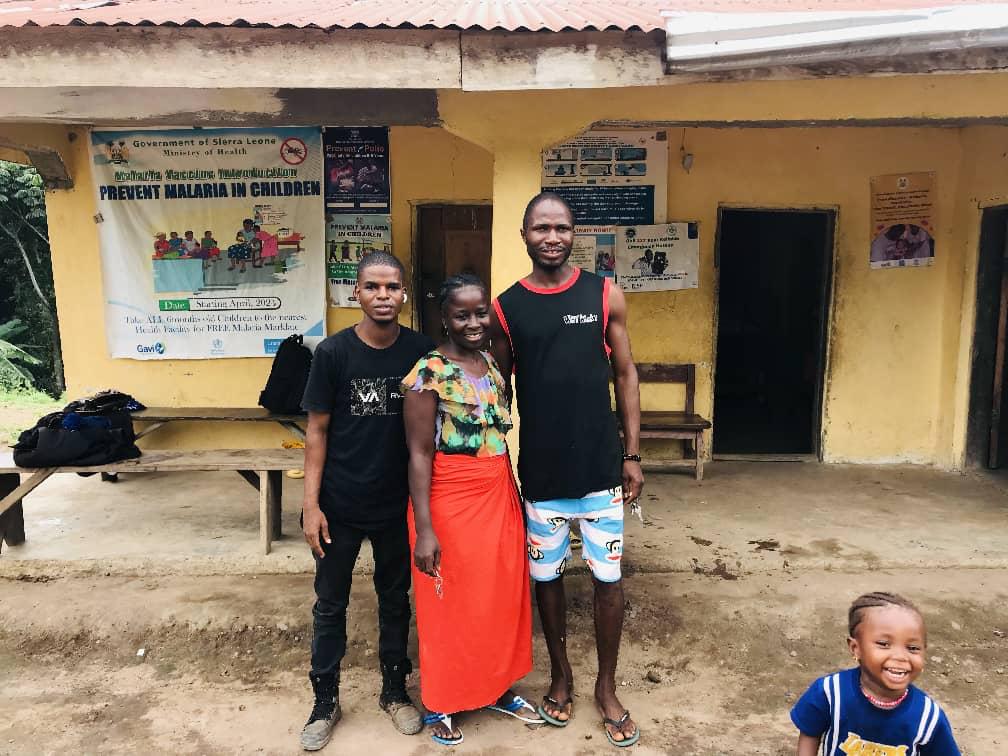
For nearly two decades, the Global Fund to Fight AIDS, Tuberculosis and Malaria has worked alongside the government of Sierra Leone and national health partners to expand access to lifesaving services and strengthen the country’s health system. Since 2005, more than $500 million USD in Global Fund investments have supported Sierra Leone’s efforts to deliver integrated HIV, TB, and malaria services while building the foundations of a resilient primary health system that can meet the needs of all people.
The government of Sierra Leone is committed to improving health care access for all people – especially those living in rural and remote areas, where long distances to health facilities present enormous challenges to those seeking care. To address this challenge, the Ministry of Health has prioritized community-led primary care through the national cadre of community health workers trained to deliver a full package of essential services directly within their communities.
In 2021 and 2022, the Ministry’s Community Health Worker Hub, together with implementing partners including Last Mile Health, completed training for the country’s first fully integrated cohort of community health workers. Over the next three years, the Ministry and partners strengthened the program through targeted quality improvement, such as a new supervision tool and a comprehensive geomapping exercise to develop a database of community health workers and primary health facilities across the country.
Building on this progress and bolstered by enduring political will and effective partnership, the Ministry of Health has an ambitious new vision to institutionalize its community health workforce. Through catalytic funding from the Building Integrated Resilience for Community Health (BIRCH) Project, a Global Fund initiative, and with technical leadership from Africa Frontline First, the Ministry has developed Vision 2030, a long-term framework for a government-led, government-financed community health workforce for all Sierra Leoneans.
From integrated care to an integrated workforce: Identifying the need
In May 2025, stakeholders from the Ministry of Health and partners convened in Bo District for a national review of Sierra Leone’s National Community Health Program. Reflecting on the major strides in developing a strong national community health workforce, supported by integrated training and improved supervision, the group set its sights on securing a long-term future for the program. Particularly in the context of shifts to the funding landscape, the Ministry of Health identified the need for a clear pathway toward institutionalizing the program, supported by sustainable funding that would fully integrate community health workers into the broader health system. Together, they aligned on a tactic to advance the program’s sustainability and development: a detailed vision for the program by 2030 and an accompanying roadmap that would guide donors’ investments and partner implementation.
“The strategy roadmap and Vision 2030 suggest concrete steps to enable the institutionalization of the National Community Health Worker Program in Sierra Leone,” explains Carlos Velázquez, Last Mile Health’s Sierra Leone Country Director. “They aim to map the shift from a volunteer-based, donor-funded program to an accredited community health worker program with increased government ownership, including salaried community health workers.”
Setting the course for an institutionalized community health worker program
Facilitated by Project BIRCH, stakeholders in Sierra Leone’s National Community Health Worker Program came together to align on pillars for institutionalizing the program, analyze its maturity, and create a vision for how the program should look and function in 2030. The process began with an initial workshop in July 2025 to establish the pillars and assess the program’s current status, as well as to draft vision statements for each pillar and outline steps to advance the program toward Vision 2030. A follow-up workshop in August 2025 allowed partners to review and refine the draft roadmap, while also identifying the need to assess district-level capacity for program ownership. Following these workshops, the project team worked with a consultant to refine and consolidate the Vision 2030 pillars and the timeline for the roadmap.
By October 2025, the Ministry of Health and its partners had established a unified vision for an institutionalized National Community Health Worker Program – and a clear timebound, step-by-step pathway to achieve it by 2030. A policy and strategy gap analysis provided additional evidence and context, comparing the current status to 2030 targets to identify areas where greater support and development would be needed in order to reach the goals set in Vision 2030.
Overall, Vision 2030 articulates a government-owned and government-led community health worker program, supported by sustainable financing and providing a standardized service package delivered by paid, professional community health workers who receive appropriate training and effective supervision. The community health workforce will be adequately supplied and supported by a strong supply chain and robust digital systems for data and reporting. These pillars align with the conditions community health workers need to succeed: they must be salaried, skilled, supplied, supervised, and operating as part of a nationally scaled workforce that is fully integrated into broader public systems. Having these conditions in place equips community health workers to perform at their best, supporting them to deliver quality care and improve health outcomes for their patients.
Looking ahead: Sustainable community-led primary care for all Sierra Leoneans
At an inflection point for the future of global health, as governments and partners rethink current funding structures and strive to “do more with less,” Vision 2030 charts a path toward sustainability and resilience for Sierra Leone’s National Community Health Worker Program. It provides the government of Sierra Leone and donors with a shared vision and an actionable, timebound roadmap outlining the steps the country must take to institutionalize the program. It centers community health workers as the leading deliverers of primary health care and advocates for their training and pay as professionals, drawing on global evidence that highlights the significant impact community health workers have in the communities they serve.
Grounded in data and informed by program maturity assessments, Vision 2030 lays out a realistic course for reaching institutionalization, ownership and sustainability. It provides an evidence-based, achievable framework through which the Ministry of Health and its partners can realize a future where quality primary care is within reach in every community in Sierra Leone, delivered by paid, professional community health workers.
For the government, the community health workers, and the people of Sierra Leone, this represents an enormous stride toward universal health coverage and better health outcomes. “Vision 2030, through Project BIRCH, has equipped the Ministry of Health with a strong tool for advocacy, alignment and coordination,” says Elizabeth Musa, National Coordinator of the National Community Health Worker Program. “Now we have a common direction, and we know what to communicate and how. Vision 2030 is the roadmap to ensure that the country progresses from volunteer community health workers to a salaried, professionalized, and recognized cadre.”